Required Safety Equipment and the Boarding Inspection
The equipment list is short, cheap and almost entirely ignored until an officer comes aboard. What ends trips is rarely a missing life jacket — it is an expired flare, a fire extinguisher nobody has looked at since purchase, and a sounding device that does not exist.
What this report covers
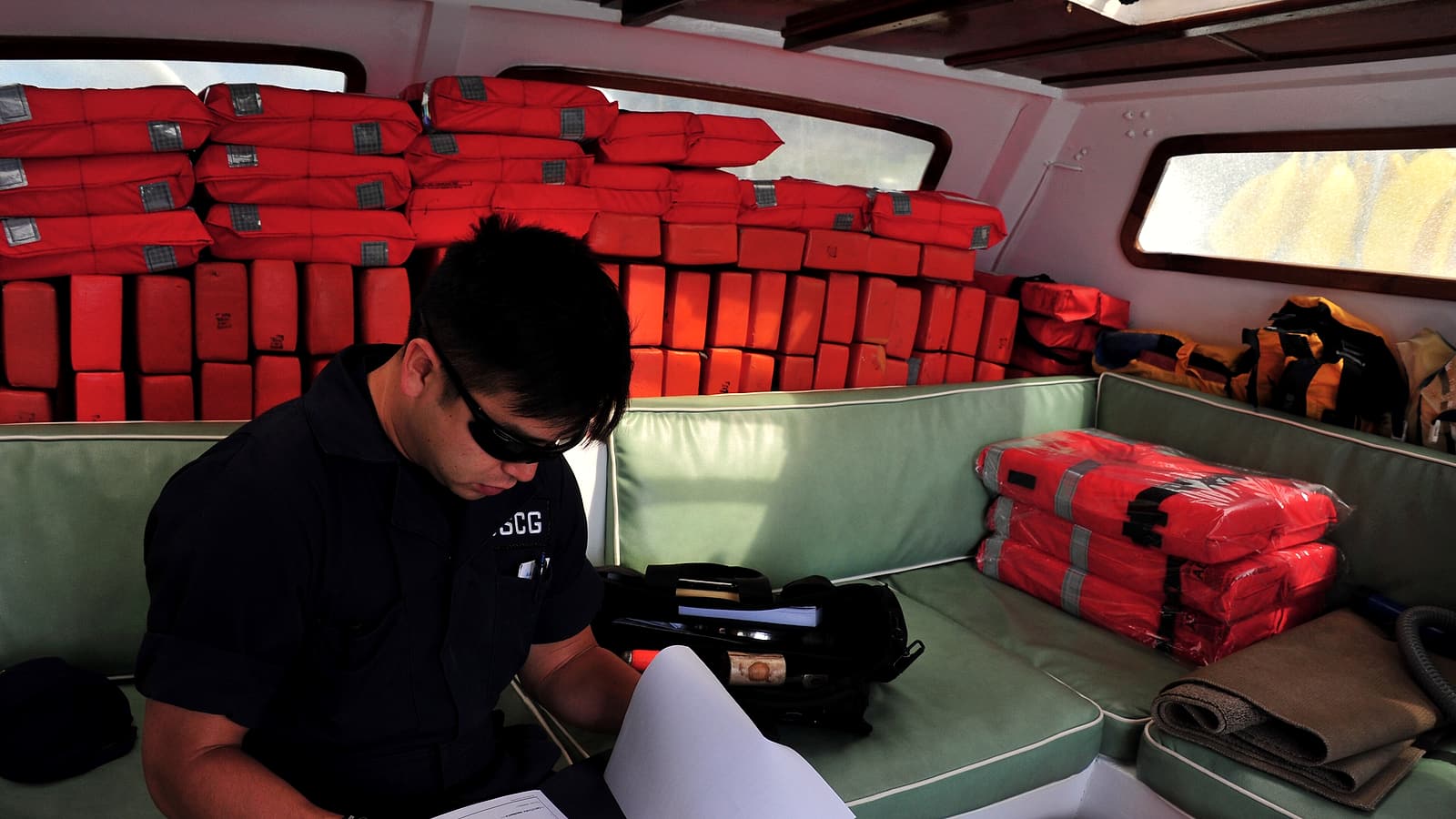
- A wearable life jacket of the right size is required for every person aboard, accessible rather than stowed away.
- Requirements scale with vessel length, and several apply only above sixteen feet.
- Visual distress signals and fire extinguishers carry expiry dates that are checked during a boarding.
- An officer may terminate a voyage for an especially hazardous condition, including missing equipment.
- Free vessel safety checks by volunteer examiners carry no penalty and identify the same defects.
Equipment enforcement on the water is unusual in that the officer does not need a reason to look. The boarding authority for a documentation and safety inspection is broad, which means the equipment check is not something a careful operator can avoid by not attracting attention.
What has to be aboard
| Item | Requirement | Common failure |
|---|---|---|
| Wearable life jackets | One of the correct size for every person, readily accessible | Stowed under gear, or adult sizes only |
| Throwable device | Required on vessels sixteen feet and over | Absent, or lashed down |
| Fire extinguishers | By vessel length and construction, current and serviceable | Discharged, corroded, or beyond service life |
| Visual distress signals | Required on coastal waters and the Great Lakes | Expired pyrotechnics |
| Sound-producing device | Capable of a four-second blast | Nothing aboard at all |
| Ventilation | For enclosed gasoline engine and fuel tank spaces | Blocked or removed ducting |
| Backfire flame arrestor | On inboard gasoline engines | Removed during maintenance |
| Navigation lights | Between sunset and sunrise and in restricted visibility | Untested until needed |
State law adds to this rather than replacing it. Common additions include a wearing requirement for children, a boater education certificate for operators of a certain age, an engine cut-off switch requirement, and a fire extinguisher on vessels that federal rules would exempt. The state rule applies alongside the federal one, and the stricter of the two governs.
Extinguishers illustrate how quietly these rules move. Older bottles were classified as B-I and B-II by capacity; newer ones carry the 5-B and 20-B markings used ashore, and the two labeling systems now appear side by side on the same vessels. Disposable extinguishers made under the newer rule carry a date of manufacture stamped into the bottle and are treated as unserviceable twelve years after it, regardless of appearance or gauge reading. Rechargeable units need periodic servicing and a current tag. An extinguisher that is present, full and visibly sound can therefore fail an inspection on a number pressed into its base.
Pyrotechnic distress signals expire forty-two months from manufacture. Fire extinguishers have a service life and a charge state. Life jackets fail on condition — torn straps, hardened foam, illegible labels. The three-minute check that prevents almost every citation is looking at dates and labels once a season.
What actually happens during a boarding
- The officer states the intention to board and directs a safe approach and speed.
- Documentation is checked — registration certificate or documentation, and identification.
- The hull identification number is compared against the paperwork.
- Equipment is inspected item by item against the list for that vessel's length.
- The officer notes any discrepancy, issues a written report, and either allows the voyage to continue or terminates it.
Most boardings end with a report and no penalty. Where a deficiency is found the outcome ranges from a warning to a civil penalty, and the officer has discretion informed by the seriousness of the gap and the operator's conduct.
What a deficiency costs
The financial consequence of a boarding is usually modest and is structured more like a parking matter than a prosecution. A deficiency produces either a warning noted on the boarding report or a notice of violation carrying a civil penalty, with the ceiling for each item set by regulation and adjusted periodically. Life jacket and distress signal deficiencies sit at the lower end. Operating without required ventilation, or with an unserviceable extinguisher, sits higher. Failing to report a reportable casualty and refusing a termination order are in a different bracket altogether.
A notice of violation is not a court summons. It offers a choice: pay the assessed amount, or send a written response to a hearing office with whatever the operator wants taken into account — proof that the equipment was aboard but stowed where the officer did not look, a receipt showing the item was replaced the same week, an explanation of the circumstances. Written responses genuinely reduce penalties, and correction promptly evidenced is the mitigating factor that works most reliably, because it addresses the only thing the process is trying to achieve.
What raises exposure is repetition and demeanor. A second boarding finding the same deficiency removes the argument that the first was an oversight, and the officer's account of the operator's conduct during the boarding travels with the file. The operator who produces the registration, opens the lockers and points out the extinguisher's date is in a materially different position from the one who does none of it.
Termination of the voyage
The most consequential outcome is not a fine. An officer who observes an especially hazardous condition may direct that the voyage terminate, and the vessel returns to the nearest safe mooring until the condition is corrected.
The conditions that trigger it are specific:
- Insufficient life jackets for the people aboard.
- Overloading beyond the capacity plate, or improper loading.
- Fuel leakage or fuel in the bilges.
- An improperly installed or ventilated engine space.
- Operation in conditions beyond the vessel's capability.
- Operation by someone apparently impaired.
Termination is an order rather than a request, and failing to comply is an offense in its own right. For a family on a day trip it is a ruined afternoon; for a charter it is a canceled contract, which is why commercial operators treat the equipment check as a pre-departure routine rather than an annual one.
The free examination nobody uses
Volunteer examiners conduct free vessel safety checks that go through the identical list. Nothing found during one produces a penalty, no report goes to any enforcement body, and a vessel that passes displays a decal for the season.
The value is not the decal. It is that the same defects — expired signals, a discharged extinguisher, missing registration numbers — are identified by someone with no power to cite you. Boaters who have one done in spring have essentially no exposure for the rest of the year.
The documentation half of the inspection
Equipment is only half of what is checked. The vessel's registration certificate must be aboard and current, the numbers and decal must be displayed correctly, and the hull identification number must match. Where the vessel is federally documented, the certificate of documentation is checked instead, and the marking requirements for a documented vessel are different from the state numbering requirements.
The most common documentation failure has nothing to do with safety at all: a vessel whose principal use has moved to a new state and which is still displaying the old state's numbers, months after the reciprocity period expired.
Sources
- eCFR — 46 CFR Part 25, Requirements for Uninspected Vessels
Carriage requirements for life jackets, extinguishers, ventilation and signals.
- eCFR — 33 CFR Part 175, Equipment Requirements
Personal flotation device and visual distress signal requirements for recreational vessels.
- Cornell Legal Information Institute — 46 U.S.C. 4302, Regulations
The statutory authority for recreational vessel equipment standards.
- Cornell Legal Information Institute — 46 U.S.C. 4308, Termination of Unsafe Operation
The authority to direct that an unsafe voyage be terminated.
- U.S. Coast Guard — Boating Safety Division
Equipment requirement summaries by vessel length and state supplements.
- U.S. Coast Guard Auxiliary — Vessel Safety Check
The free voluntary examination that checks the same items without penalty.
Questions readers ask
Do life jackets have to be worn?
Federal law requires that a wearable device of the correct size be available for every person aboard and be readily accessible, not that adults wear them. Children under a specified age must wear one while underway on most vessels, and the age varies by state where a state rule applies. Certain activities and vessel types — personal watercraft, water skiing, some whitewater — carry a wearing requirement in most states.
How do officers check whether flares are current?
By reading the expiry date printed on them, which is one of the first things looked at. Pyrotechnic signals expire forty-two months from manufacture, and expired ones do not count toward the requirement even though many boaters keep them aboard as spares. Keeping expired flares is permitted; relying on them for the carriage requirement is not.
What is a termination order?
An order directing that the voyage end, issued where an officer observes an especially hazardous condition — overloading, an absence of required life jackets, fuel leakage, an improperly installed engine, or operation in unsafe conditions. It is not an arrest, and the usual outcome is that the vessel returns to the nearest safe mooring until the condition is corrected. Refusing to comply is a separate offense.